


We act today for a better environment tomorrow.
2.2 Resource Efficiency



Together for a better future
Our mission is clear: to steadily increase our contribution to climate and environment protection – effectively, measurably and with long-lasting impact.
Our industry carries significant environmental responsibility. This includes not only reducing GHG-emissions but also using resources as efficiently as possible. It is therefore our obligation to consistently lower GHG-emissions while simultaneously minimising resource consumption. We are fully aware of this responsibility. As an international logistics company, we take targeted action where our leverage is strongest.
Our measures include:
Energy-efficient and climate friendly operation of logistics properties
Continuous development of renewable energy
Testing and deployment of alternative drive technologies and fuels
Reducing packaging material and advising our customers on resource efficiency

Focus Topic
2.1 Climate action and environmental protection
Because it is our mission to reduce emissions.
Climate action and environmental protection
We consistently align our business decisions with climate-mitigation
and environmental-compatibility objectives. In doing so, FIEGE assumes responsibility during the climate crisis.
We explicitly commit to the 1.5°C target of the Paris Agreement. To anchor this scientifically, we submitted our emissions reduction targets to the Science Based Targets initiative (SBTi) at the beginning of 2025. These targets were officially validated as aligned with the Paris Agreement in the summer.
A structured approach is essential. Our comprehensive transition plan defines:
Ambitious, science-based guidelines
Concrete measures to reduce emissions
Continuous monitoring to transparently track and manage our progress
Where exactly are emissions generated – and where can we reduce them most effectively? Our greenhouse-gas balance provides the answer.


Direct emissions from owned or controlled sources such as vehicle fleet emissions.
Indirect emissions from the generation of purchased electricity, steam, heating and cooling consumed by our organisation.
All other indirect emissions that occur in our value chain, including both upstream and downstream emissions, such as emissions from business travel or waste management.
Allocation of emissions
Our greenhouse gas inventory provides a detailed overview of where emissions originate and what potential savings are available. This data serves as the foundation for developing and implementing targeted reduction measures.
Emissions breakdown by scopes
In the 2025 financial year, our total emissions across all scopes amounted to 271,142 t CO2e. Our emissions remained unchanged – while our revenue grew by 4.1%. Nevertheless, we must intensify our decarbonisation efforts to achieve our climate targets.


Now that we have assessed our current carbon footprint through our CO₂e balance and defined our climate goals, the next step is to implement measures to achieve those goals.
Halve
emissions.
Net-zero
emissions.
How did our consumption within the scopes develop over the past year? Based on these figures, the priority action areas for the coming year can be identified to continue the positive trend.
A decrease of 8% compared with 2024
Key drivers: replacement of oil and gas heating systems, installation of heat pumps, and electrification of the vehicle fleet (cars and trucks)
This effect reflects real savingscompared with the previous year
A decrease of 43% compared with 2024
Key driver: the continued expansion of renewable electricity generation
This effect reflects real savings compared with the
previous year
Change compared with the previous year: + 4%
The commissioning of external transport service providers (Category 3.4) remains our largest emissions driver, accounting for well over half of our Scope 3 emissions
The year‑on‑year change is partly due to volume effects and partly to improvements in data availability for purchased products and commissionedtransport services, which cannot be fully reconstructed for previous years

Energy
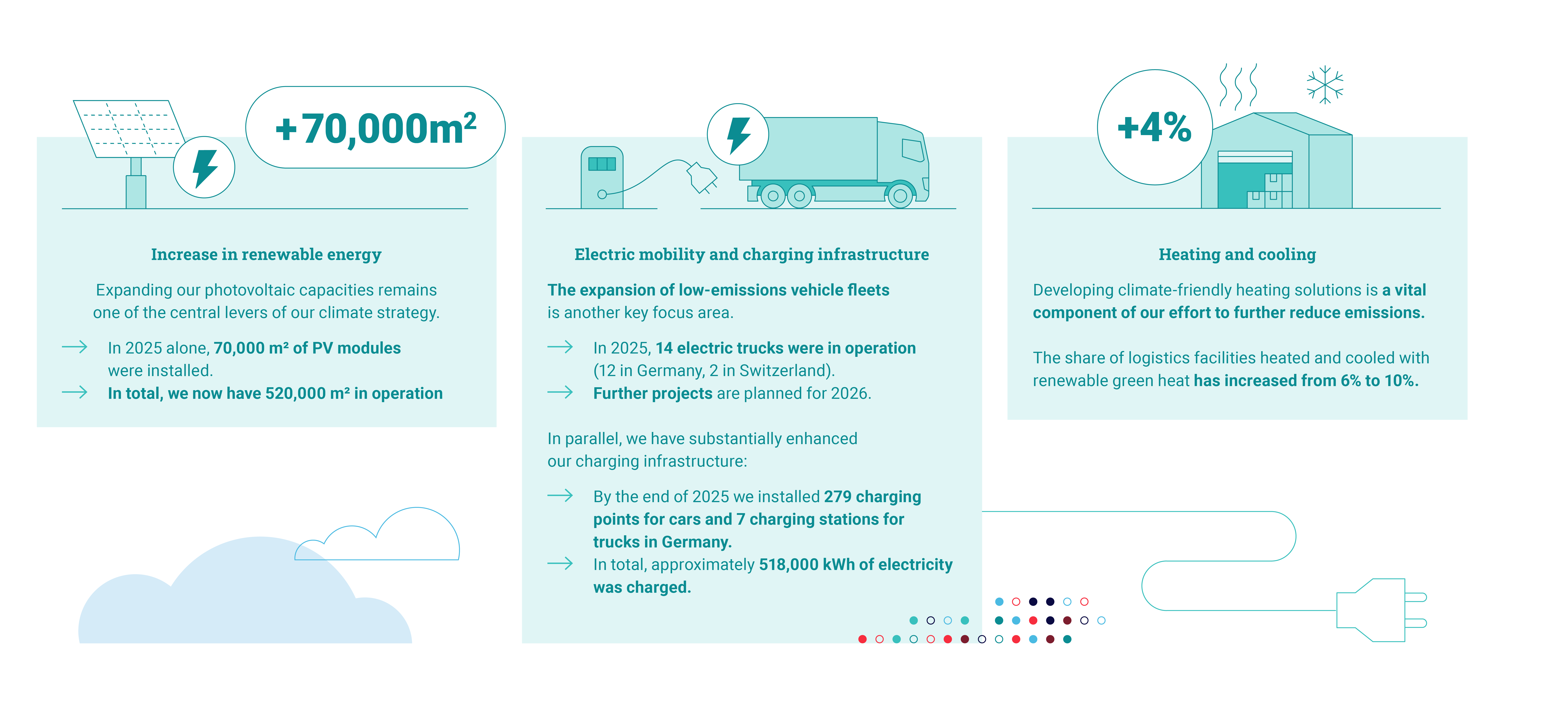
We are in the midst of transforming our logistics centres into integrated energy centres – a shift that brings significant advantages. Once fully implemented, our sites will not only fully meet our own needs, but can also supply the public grid with green electricity.
2.2 Resource efficiency
Because scarce resources
require new approaches.
Circular Economy
Because resources create more value in circular systems
Linear value chains built on the “take-make-waste” model are no longer viable. Circular value creation models offer a future-ready alternative, combining ecological responsibility with measurable economic benefits. By enabling, closed material loops and increasing transparency along the supply chain, resources can be used far more efficiently – keeping recyclable materials in circulation for much longer.
But this transition raises questions. Where does a company begin? Which processes need to change, which partners are required, and how can a complex supply chain be transformed toward a circular economy?
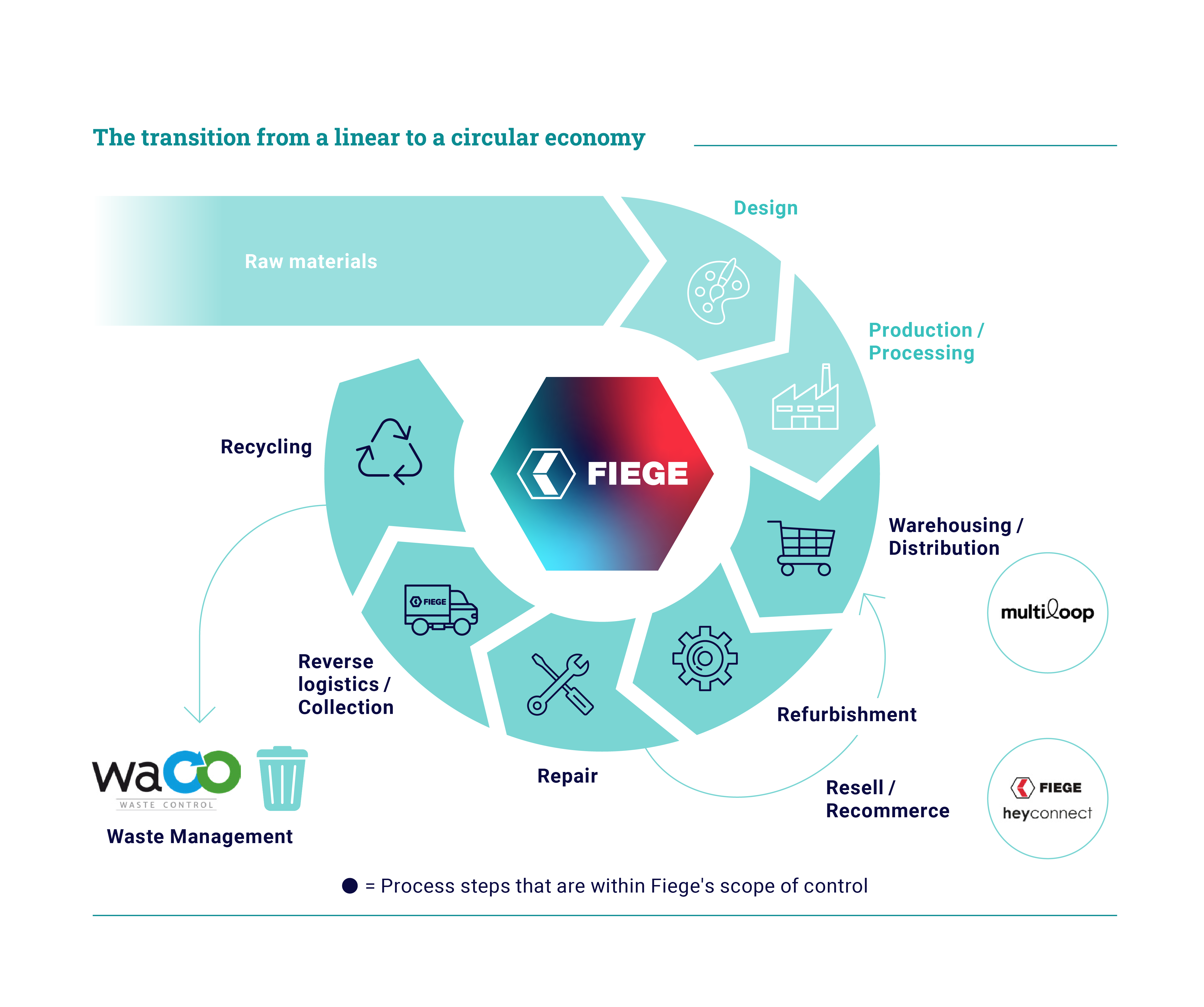
Closing loops. Securing value creation.
As a logistics service provider, we not only connect material flows, data, and partners along the value chain, but also take on operational steps that make circular systems possible. We organize return processes, manage spare‑part and reuse flows, prepare materials, and enable transparent lifecycle tracking. In this way, we create seamless end‑to‑end processes in which logistics, data, and partnerships interact to enable circular solutions.
To systematically advance our customers’ circular‑economy ambitions and support them as effectively as possible in addressing their challenges, we focus on four central fields of action:
Circularity, orchestration
and data transparency
Creating value
from returns
Returns and
waste management logistics
Participation in and integration with sustainability start-ups
Don’t waste it, use it!
Clear recommended actions, structured structures and unequivocal principles form the foundation of our approach.
We record waste volumes and types at each location in accordance with the Waste Catalogue Ordinance, making incorrect sorting and sorting inputs transparent and measurable.
Based on this data, we identify improvement potential and reduce
waste directly at its source.
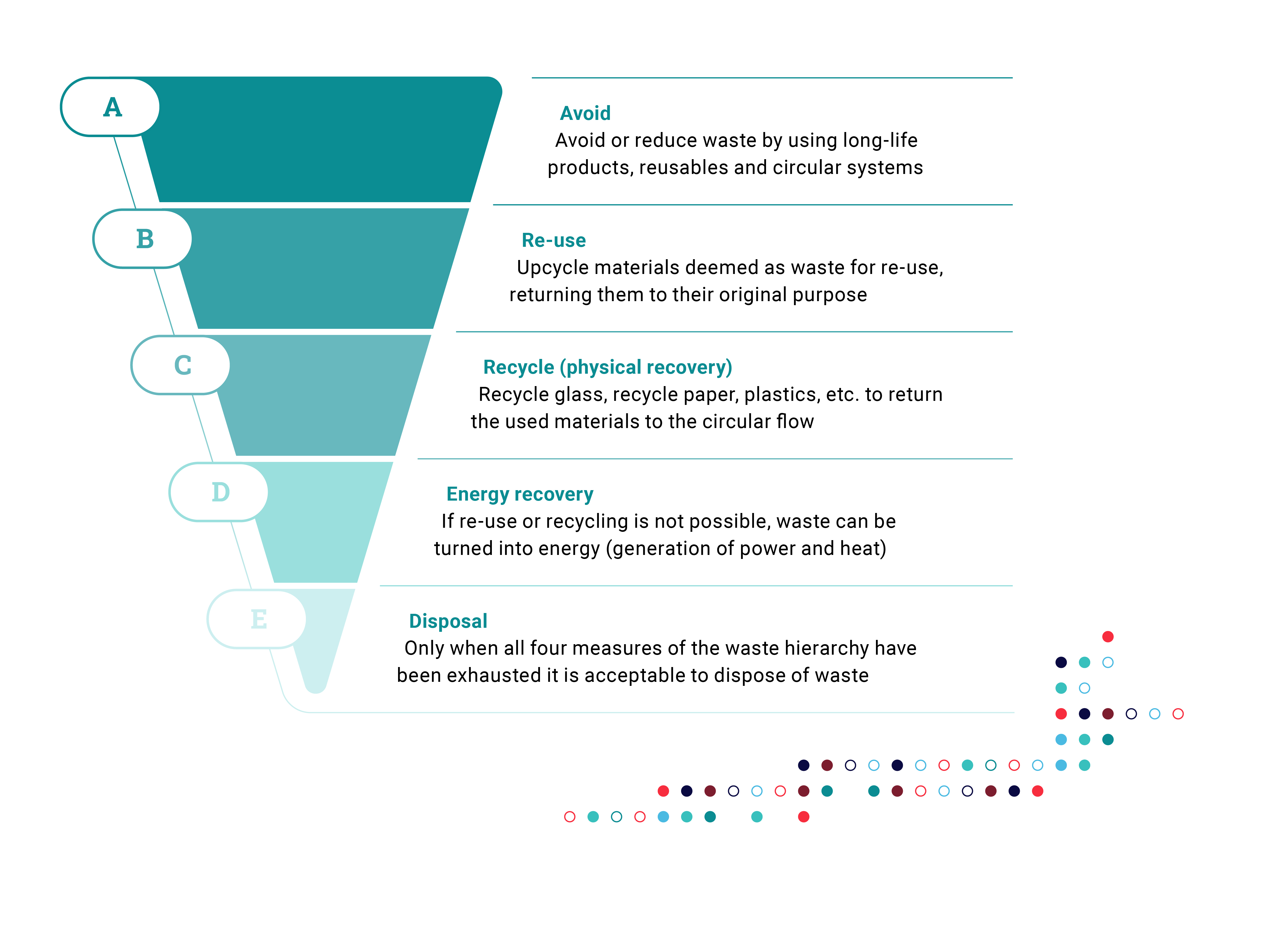
Our ambition is to prevent waste wherever possible, maximize recycling rates, and return recyclable materials to the value chain in a resource friendly manner.
Zero-Waste-Hierarchy
FIEGE ReLog GmbH – thinking of waste as a raw material
Our Waste Control (WaCo) department has been in operation since 2005 as a certified specialist waste management facility and is audited annually by DEKRA. Its objective is to treat waste consistently as a recyclable material and return as much of it as possible into the resource cycle.
The name WaCo stands for ‘Waste’ and ‘Control’. In this context, we do not understand ‘Waste’ as refuse, but as residual materials with raw‑material potential that can be returned to the resource cycle.
The term ‘Control’ describes WaCo’s role as a central partner to our FIEGE sites and our customers. Together with them, WaCo oversees and manages all steps involved in handling residual materials – from the careful assessment of arising materials to the coordination of take‑back, sorting, and recovery processes, all the way to the transparent management of input and output.
FIEGE ReLog GmbH – thinking of waste as a raw material
Waste management and recycling
Focus on reuse, energy recovery and – only where necessary – sustainable disposal.
Circular economy
Take-back programmes tailored to customer needs for electronic waste, disassembly services, repairs as well as refurbishment solutions to maximise material value recovery.
Certification & Reporting
Data-driven monitoring of waste streams and
recycling rates.
Increasing efficiency and awareness
Promoting environmental awareness across the entire organisation and encouraging the use of recycled materials.

Outlook
Implementation of the SBTi‑validated climate targets through prioritised measures in energy‑ and emissions‑intensive areas
Further development of the emissions inventory with a focus on activity‑ and quantity‑based data, particularly in Scope 3
Continued electrification of the vehicle fleet and needs‑based expansion of charging infrastructure
Expansion of our proven circular‑economy approaches to new industries and customer contexts
Development of a waste dashboard
Conducting a climate‑risk analysis at our sites
Preparation of the Climate Transition Plan 2030
Reduction of Scope 3 emissions to achieve our ambitious SBTi‑aligned climate targets


FIEGE Sustainability Report 2025
Detailed information, figures and content on all fields of action can be found in the full Sustainability Report 2025.

